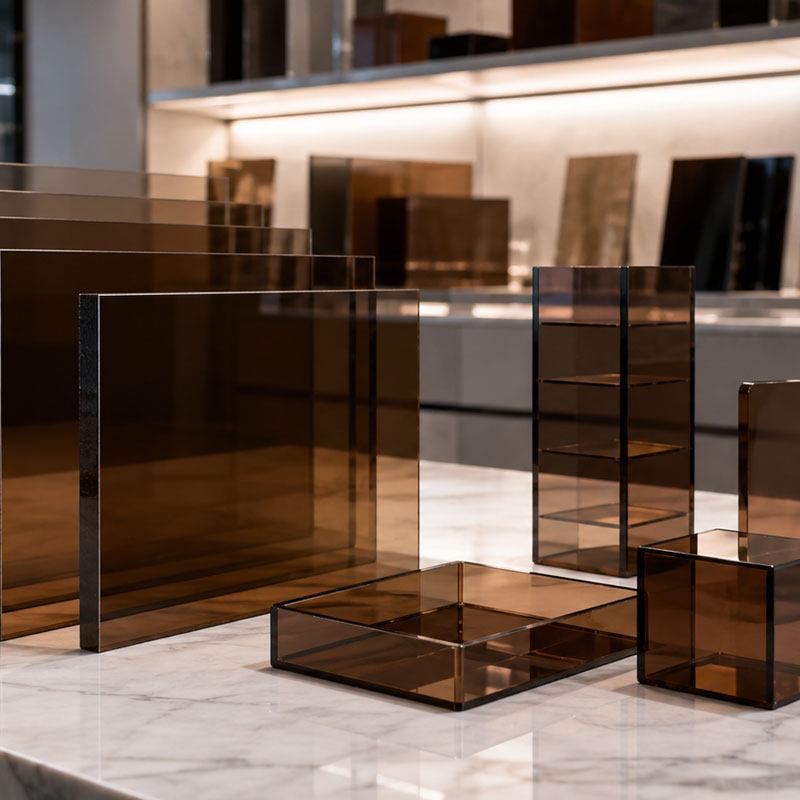
Brown acrylic is frequently selected because it creates a warmer and more premium visual effect than clear plastic, standard gray glazing or painted sheet. Yet “brown” is not a complete material specification. A transparent bronze panel, a translucent coffee-colored diffuser and an opaque chocolate-brown decorative board can look related in a sample book while behaving very differently in a finished display, partition, cabinet door, sign or architectural feature.
For B2B buyers, the purchasing risk is rarely limited to choosing the wrong shade. Problems often appear after the order is cut, polished, illuminated, bonded or installed. The same nominal color may look lighter in a 2 mm sheet than in a 10 mm sheet. A sample viewed against white paper may appear darker once installed in front of an open space. A glossy surface may emphasize scratches in retail lighting. A transparent brown panel may reveal fasteners, cables and adhesive lines that were invisible in the drawing.
This guide explains how to convert a visual idea into a measurable brown acrylic requirement. It covers material definition, light transmission, shade control, thickness, fabrication, thermal movement, cleaning, sample approval and supplier qualification. The goal is to help designers, fabricators, signage contractors, retail fixture companies and importers reduce rework and obtain repeatable results from prototype through mass production.
What Is a Brown Acrylic Sheet?
A brown acrylic sheet is a colored polymethyl methacrylate (PMMA) panel whose pigment or dye system produces a brown, bronze, amber-brown or coffee-colored appearance while retaining the fabrication characteristics of acrylic.
PMMA is a transparent thermoplastic commonly known as acrylic or acrylic glass. Clear grades can transmit up to approximately 92% of visible light, while colored grades intentionally reduce or filter that transmission. Brown colorants can be formulated for transparent, translucent or opaque effects. The final appearance therefore depends on more than the color name: it also depends on sheet thickness, light source, background, surface finish and viewing distance.
The density of standard PMMA is approximately 1.18 g/cm³, which is roughly half the density of common soda-lime glass. This weight difference can simplify handling, shipping and support-frame design, although acrylic requires more attention to scratching and thermal expansion. The material can be saw-cut, CNC-routed, laser-cut, drilled, polished, bonded and thermoformed when the correct process is used.
AML lists brown and bronze options for commercial projects, including transparent and opaque codes. Buyers evaluating a brown acrylic sheet should request the current color card, transmission data, available thicknesses and a physical sample rather than approving a purchase from a screen image alone.
Why Brown Acrylic Sheet Specifications Need More Than a Color Name
A complete brown acrylic specification identifies the visual target, optical behavior, dimensions, surface condition, fabrication route and acceptable production tolerance.
Terms such as bronze, smoke brown, tea brown, coffee, chocolate, caramel and dark brown are descriptive rather than universal standards. Two suppliers may use the same term for visibly different colors. Even within one product family, a transparent bronze grade may have several transmission levels. A buyer who writes only “5 mm brown acrylic” leaves important decisions unresolved.
A useful specification should answer six questions:
Should the sheet be transparent, translucent or opaque?
What approved color code or physical master sample defines the shade?
What thickness and finished dimensions are required?
Will the sheet be viewed with front light, backlight or transmitted daylight?
Which processes will be performed after delivery?
Which visual and dimensional tolerances must be controlled across batches?
The required detail depends on the application. A decorative cabinet insert may tolerate modest shade variation, while a chain-store rollout may require hundreds of panels from different production lots to match under the same lighting. A protective screen may prioritize visibility and impact behavior, while an illuminated logo may prioritize transmission and edge quality. The specification must reflect the finished function, not only the flat-sheet appearance.
How to Select Brown Acrylic Sheet Light Transmission
Light transmission is the percentage of incident visible light that passes through a sheet under a defined test method and thickness.
Transmission is the most important distinction between transparent bronze, translucent brown and opaque brown acrylic. AML’s brown product data presents representative bronze grades with transmission levels above approximately 29%, 21% and 12%, together with an opaque brown option listed at 0%. These values show why the color name alone is insufficient: panels that all appear “brown” on a small card can produce very different privacy, brightness and background-visibility results.
For transparent brown glazing, the transmitted view should remain visible. This is suitable for display covers, partitions, decorative windows and protective panels where visual connection is still required. A lower transmission grade creates more privacy and stronger color saturation, but it may reduce visibility in dim spaces.
Translucent brown material scatters light and softens objects behind the sheet. It is useful for diffuser panels, feature walls and illuminated decorative components where a glowing surface is more important than a clear view. The buyer should evaluate both total transmission and diffusion because two materials with similar total transmission can have different hotspot behavior.
Opaque brown acrylic blocks direct visibility and is commonly used for solid-color signs, cabinetry, wall panels, display bases and furniture components. In this case, the key visual parameters are surface gloss, color consistency, opacity and resistance to light leakage at thin areas or machined edges.
| Brown Acrylic Type | Typical Visual Result | Best-Fit Applications | Main Approval Check |
|---|
| Transparent bronze | Objects remain visible through a warm tint | Partitions, display covers, decorative glazing | Transmission, color neutrality and view clarity |
| Dark transparent brown | Reduced visibility with stronger privacy | Premium enclosures, furniture doors, privacy panels | Appearance under actual room lighting |
| Translucent brown | Soft glow with blurred background | Light boxes, diffusers, feature walls | Uniformity, hotspot control and haze |
| Opaque brown | Solid color with no direct transmitted view | Sign faces, cabinet parts, display structures | Opacity, gloss and edge color |
Transmission should be measured using a defined method where the value is critical. ASTM D1003 is commonly used for luminous transmittance and haze in transparent plastics. For procurement, the buyer should state the test method, thickness, conditioning and acceptable range. A value measured on 3 mm material should not automatically be applied to 8 mm material because optical path length affects the result.
How Lighting and Background Change the Appearance of Brown Acrylic
Definition: Perceived acrylic color is the visual result of the sheet, its thickness, the illumination spectrum, the background and the viewing geometry.
A sample can appear attractive on a sales desk and disappointing in the final installation because the viewing conditions changed. Warm-white LEDs may intensify red and amber tones, while cool-white LEDs may make the same panel appear grayer. Daylight varies throughout the day and can reveal differences that are less visible under showroom lighting.
Background color also matters. A transparent brown sheet placed over white material appears lighter and more saturated than the same sheet over a dark cavity. An open background can increase depth, while a reflective metal backing may create glare. If cables, brackets or adhesive tapes sit behind the panel, the selected transmission level must hide or intentionally reveal them.
For a retail or hospitality project, evaluate the sample in at least three conditions: front-lit against the proposed background, backlit with the intended LED color temperature, and unlit under typical ambient light. Photographing these conditions is useful for communication, but final approval should be based on physical samples because camera exposure and screen calibration can distort color.
When multiple brown shades are being considered, AML’s broader color acrylic sheets range can help buyers compare brown against gray, amber, orange, red and other adjacent colors before locking the project palette.
Brown Acrylic Sheet Thickness Selection
Brown acrylic sheet thickness is selected by balancing stiffness, span, edge appearance, fabrication method, transmitted color and finished-part load.
AML’s brown acrylic product information lists a standard sheet size of 1220 × 1830 mm and thickness options extending from thin sheets to heavier panels, subject to color code and production availability. The right thickness is not determined by aesthetics alone. A large unsupported panel may bow even when the material is strong enough not to break, and a thicker transparent brown sheet will generally look darker because light travels through more colored material.
Thin sheets around 2–3 mm are useful for small inserts, sign components, decorative overlays and fabricated parts with sufficient support. They are economical and easy to cut, but large flat areas may flex and reveal waviness. Thin transparent grades can also look noticeably lighter than the approved thick sample.
Medium thicknesses around 4–6 mm are common for retail fixtures, cabinet doors, room-divider modules, signage panels and display covers. They offer greater stiffness and more substantial polished edges. Designers should confirm whether the frame allows thermal movement and whether the panel needs intermediate support.
Thicker sheets around 8–12 mm create a premium edge appearance and higher stiffness for shelves, furniture features, partitions and structural-looking decorative elements. They require more capable cutting and polishing equipment, and their weight, cost and thermal expansion become more significant. A thick sheet should not be specified merely to look “high quality” if a supported thinner panel can meet the function more efficiently.
The final thickness decision should be validated with the actual panel dimensions and mounting method. A 600 mm square insert and a 1800 mm tall divider have different deflection behavior even at the same thickness. For demanding installations, the fabricator should calculate or test deflection under expected loads rather than relying on a generic thickness chart.
Brown Acrylic vs Smoked Gray Acrylic, Glass and Wood-Look Panels
Material comparison should evaluate appearance, weight, fabrication, optical effect, maintenance and installation risk rather than comparing purchase price alone.
Brown acrylic is often evaluated against smoked gray acrylic, tinted glass and wood-look decorative panels. Each alternative can create a premium interior effect, but their visual language and processing requirements differ.
| Material | Visual Character | Weight and Handling | Fabrication | Key Limitation |
|---|
| Brown acrylic | Warm, modern, transparent to opaque options | About half the density of common glass | Cut, drill, polish, bond and thermoform | Scratches more easily and expands with heat |
| Smoked gray acrylic | Cooler, neutral and technical | Similar to brown acrylic | Similar acrylic processing | Can feel less warm in hospitality interiors |
| Tinted glass | Hard, crisp and premium | Heavier; requires careful handling | Specialized cutting and edge processing | Higher breakage risk and limited post-processing |
| Wood veneer or laminate | Natural texture and strong opacity | Depends on substrate | Carpentry and panel-processing methods | Does not provide transparency or glowing edges |
Brown acrylic is particularly useful when the design needs warmth without losing the depth, reflectivity or transmitted-light effects of a polymer sheet. It can also bridge material palettes by visually connecting metal, wood, leather and warm lighting. Smoked gray is more neutral and often preferred for electronics or minimalist environments. Glass provides greater surface hardness, while wood-look panels provide tactile texture and complete opacity.
The best choice may combine materials. For example, an opaque brown acrylic logo can sit on a wood panel, or a transparent bronze door can be framed in black metal. The specification should identify what each material contributes instead of forcing one panel to satisfy every visual and structural need.
Brown Acrylic Sheet Fabrication: Cutting, Drilling and Edge Finishing
Brown acrylic fabrication is the controlled conversion of flat sheet into finished parts through cutting, machining, drilling, polishing, bonding or forming.
Fabrication quality strongly affects the final impression. Dark glossy sheets highlight edge chips, scratches and adhesive marks. Transparent brown material can reveal internal stress and tool paths. The chosen process should therefore be matched to the finish requirement before the material is ordered.
Saw and CNC Cutting
Panel saws and CNC routers are suitable for straight cuts, shaped parts, pockets and holes. Sharp tools, stable fixturing and suitable feed rates reduce chipping and heat buildup. Protective film should remain on the sheet for as long as practical, but the fabricator must confirm that the film is compatible with the cutting method and will not melt into the edge.
Laser Cutting
Laser cutting can produce clean profiles and glossy-looking edges, especially on cast acrylic. However, dark pigments absorb laser energy differently from clear material, so power and speed should be tested on the exact grade and thickness. Excessive heat may create bubbles, flaming, edge discoloration or stress. Parts that will be bonded or exposed to chemicals may require additional stress-control measures.
Drilling
Holes should be positioned with sufficient edge distance and produced using acrylic-compatible drill geometry. The sheet must be supported to prevent breakout. Oversized holes or slotted details may be needed where fasteners must accommodate thermal movement. Screws should not clamp the sheet so tightly that expansion produces cracking.
Edge Polishing
Machined, buffed, flame-polished and diamond-polished edges produce different results. A polished transparent brown edge can appear darker and richer than the face because the light path is longer. The buyer should approve the finished edge appearance, not only the flat surface. Flame polishing is fast but may introduce stress, while precision machining and diamond polishing provide better control for premium exposed edges.
Before mass production, AML recommends confirming the intended downstream process. This allows the material grade, protective film and tolerance plan to be reviewed together with the fabricator’s equipment.
Thermoforming Brown Acrylic Without Color Distortion
Thermoforming heats acrylic into a formable state and shapes it over or into a mold while controlling stretch, surface quality and residual stress.
Brown acrylic can be bent or formed into trays, covers, curved signs, furniture details and decorative enclosures. The visual challenge is that stretched areas become thinner and can appear lighter. Deep draws may therefore create a color gradient even when the flat sheet is perfectly uniform.
Heating must be even across the sheet. Cold zones resist stretching and may whiten or create stress, while overheated areas can sag, bubble or lose surface quality. Dark sheets may absorb radiant heat more rapidly than clear grades, so a forming recipe developed for clear acrylic should not be copied without trials.
The mold radius, draw depth and clamping design should minimize local thinning. For a color-critical part, the buyer should approve a formed sample from the production-intent mold. A flat color chip cannot predict how the final component will look at corners, ribs or stretched walls.
When the part has a visible glossy face, tooling marks and dust control are important. The forming surface should be clean, and the protective film must be removed or retained according to the supplier’s recommendation. After forming, the part should cool in a controlled condition before trimming to reduce distortion.
Thermal Expansion and Installation Clearance
Thermal expansion is the dimensional change that occurs when acrylic temperature rises or falls.
PMMA expands more than glass or metal. Representative acrylic technical data often shows a linear thermal expansion coefficient near 0.07 mm per meter per degree Celsius, although the exact value depends on grade. Using that value for an engineering estimate, a 1,000 mm panel exposed to a 30°C temperature change may move by about 2.1 mm:
Expansion = length × coefficient × temperature change
1.0 m × 0.07 mm/m·°C × 30°C = 2.1 mm
This movement is not a defect; it is a material characteristic that must be accommodated. Outdoor signs, shopfront panels, sunlit partitions and panels near lighting equipment can experience meaningful temperature changes. Rigidly trapped edges or tightly fitted screws may create bowing, crazing or cracks.
Frames should provide suitable clearance, and holes may need to be larger than the fastener shank. Gaskets and clips should support the panel without preventing movement. The exact allowance should consider panel size, expected temperature range, installation method and the material supplier’s data.
Because metal frames expand at a different rate, the interface design matters. Long panels should not be bonded continuously to a metal substrate unless the adhesive system is designed to absorb differential movement. Mechanical retention with controlled clearance may be safer for large installations.
Surface Finish, Scratch Visibility and Cleaning
Surface management controls gloss, reflection, scratch appearance and maintenance throughout fabrication, transport and use.
Glossy brown acrylic creates strong reflections and a deep, polished look, but it also makes dust, fingerprints and fine scratches more visible under directional lighting. Matte or satin surfaces reduce glare and may be more forgiving in high-touch environments. The finish should be selected according to the maintenance conditions rather than photography alone.
Protective film should remain intact during storage and most fabrication steps. Worktables must be clean, and sheets should not slide across abrasive debris. Finished parts should be separated with clean interleaving material. Packaging must prevent the face from rubbing against cartons, hardware or another panel during transport.
For cleaning, use a soft microfiber cloth with mild soap and water. Abrasive pads and cleaners containing ammonia or aggressive solvents can damage the surface. Dry wiping dusty acrylic can create fine scratches, so loose particles should be rinsed or blown away before wiping.
If the application requires frequent public contact, consider a hard-coated grade or a replaceable protective strategy. Standard PMMA is not as scratch-resistant as glass. A realistic maintenance plan is therefore part of material selection, especially for counters, doors and interactive displays.
Batch-to-Batch Color Control for Brown Acrylic Sheet Orders
Batch color control keeps production sheets within an agreed visual and instrumental range relative to an approved master.
Color consistency becomes critical when a project is delivered in phases. Panels installed side by side may come from different production lots, and small differences can become visible under uniform lighting. The risk increases with large surfaces, high-gloss finishes and transparent grades.
The buyer should retain an approved master sample identified by supplier, code, thickness, finish and approval date. The supplier should retain a matching reference. If the project requires instrumental control, define the color space, illuminant, observer, measurement geometry and maximum tolerance. A generic statement such as “same color” is difficult to enforce without a shared method.
For transparent brown acrylic, color measurement should be combined with transmission measurement. Two sheets may have similar face color but different optical density. Visual approval should include the intended background and lighting because instrumental agreement does not guarantee identical appearance in every installation.
Large projects should consider producing the full visible set from one batch. When that is not possible, arrange panels so that different lots are not directly adjacent, or approve a controlled range before production. Replacement stock should be retained when future repairs are likely.
Quality Inspection Before Fabrication
Incoming inspection verifies that sheet identity, dimensions, color, surface and packaging match the purchase specification before value-added processing begins.
Inspection should occur before cutting because a fabricated part is harder to return or reclassify. The receiving team should verify the label, color code, thickness, sheet size, quantity, protective film and batch information. Visual inspection should be performed under consistent lighting.
Common checks include scratches, inclusions, bubbles, dents, edge damage, contamination, waviness and film defects. Transparent grades should be viewed both against a bright background and in reflection. Opaque grades should be checked for pinholes or light leakage where required.
Thickness should be measured at multiple locations with suitable equipment. Dimensions and squareness should be checked according to the agreed tolerance. For optical projects, representative sheets should be tested for transmission and haze. For CNC nesting, verify that usable area remains after damaged edges are excluded.
A simple incoming record should include purchase order, supplier, batch, date, sample photos, measurements, acceptance decision and retained sample location. This creates traceability if a later fabrication problem is linked to material variation.
How to Qualify a Brown Acrylic Sheet Supplier
Supplier qualification confirms that a manufacturer can reproduce the required material, document it and support the buyer from sampling through repeat orders.
A capable supplier should be able to explain the difference between available shades, provide physical samples, identify transmission data and confirm which thicknesses can be produced consistently. Buyers should ask whether the material is cast or extruded, because fabrication and thickness behavior may differ.
AML states that it operates production bases in China and Indonesia with eight production lines and serves global markets through its AML, ALMOLLY and STS brands. For a B2B program, production scale is useful only when it is connected to batch control, inspection, documentation and responsive technical communication.
Supplier evaluation should include the following:
Current color code and physical sample availability
Sheet type, raw material route and production method
Thickness, size and tolerance capability
Transmission, haze or opacity data where relevant
Protective film and export packaging system
Color control and retained-sample procedure
Fabrication guidance for cutting, bonding and forming
MOQ, production lead time and repeat-order traceability
Buyers seeking broader sourcing support can also review AML as an acrylic sheet manufacturer in china and confirm which production base, brand and documentation package will apply to the order.
Prototype and Sample Approval Workflow
A sample approval workflow progressively confirms color, optical behavior, fabrication response and finished-part appearance before bulk production.
The first sample should be used to narrow the color family, not to authorize mass production. After the preferred code is identified, request a sample in the intended thickness. View it under the proposed lighting and background. If the part will be formed, polished or illuminated, fabricate a representative prototype.
Digital review: Use photos or color charts only to shortlist options.
Physical chip approval: Compare several shades in person.
Full-thickness sample: Confirm transmission and perceived darkness.
Fabrication trial: Cut, drill, polish, bond or form the actual grade.
Assembly mockup: Install with the proposed frame, lighting and hardware.
Golden sample: Sign and retain the final approved reference.
Pre-production confirmation: Compare the first production batch with the golden sample.
This process may appear slower than ordering from a photograph, but it reduces the risk of replacing finished panels. The cost of one representative prototype is usually small compared with the labor, freight and schedule impact of a color mismatch discovered after assembly.
Brown Acrylic Sheet RFQ Checklist
An RFQ checklist gives the supplier the information required to recommend the correct brown acrylic grade and prepare a comparable quotation.
| RFQ Item | Information to Provide | Why It Matters |
|---|
| Application | Signage, partition, furniture, display, lighting or other use | Determines optical and durability priorities |
| Visual target | Transparent, translucent or opaque; reference image or sample | Prevents ambiguity around “brown” |
| Color approval | AML code, physical master or target range | Creates a repeatable color reference |
| Thickness and size | Finished or stock dimensions and quantity | Affects availability, weight and nesting |
| Transmission | Target value, test method and tolerance if critical | Controls privacy and illumination |
| Surface | Gloss, matte, texture, coating and protected faces | Controls appearance and handling |
| Fabrication | Laser, CNC, drilling, bonding, bending or forming | Supports grade and process selection |
| Environment | Indoor/outdoor, temperature, UV, cleaning and chemicals | Identifies durability requirements |
| Inspection | Color, dimensions, surface, optical tests and documents | Aligns acceptance criteria |
| Commercial terms | MOQ, delivery location, schedule and packing needs | Enables a usable B2B quotation |
Include drawings where possible. Mark visible surfaces, exposed edges, hole positions and any dimensions that affect installation. For phased projects, state the expected total volume and repeat-order schedule so that batch planning can be discussed early.
Frequently Asked Questions About Brown Acrylic Sheet
These FAQs answer common procurement, design and fabrication questions about brown acrylic material.
1. Is brown plexiglass the same as brown acrylic sheet?
In common commercial use, plexiglass is a familiar name associated with PMMA acrylic. Buyers should still confirm the actual polymer, production method, grade and supplier because trade names do not replace a technical specification.
2. Does a thicker brown acrylic sheet look darker?
Usually yes for transparent colored material. A longer optical path absorbs more light, so an 8 mm sheet may appear darker than a 3 mm sheet of the same formulation. Always approve the intended production thickness.
3. Can brown acrylic be used outdoors?
Many PMMA grades have good weatherability, but outdoor performance depends on pigment, UV stabilization, exposure, temperature and cleaning. Request the supplier’s grade-specific recommendation and test the intended color.
4. Can brown acrylic sheet be laser cut?
Yes, acrylic is commonly laser cut. Settings must be developed for the exact thickness and pigment because dark material absorbs energy differently. Evaluate edge color, stress, bubbles and the needs of subsequent bonding.
5. How do I prevent brown acrylic panels from cracking around screws?
Use suitable hole geometry, adequate edge distance, smooth drilled edges, compatible washers or gaskets, and enough clearance for thermal movement. Do not overtighten fasteners or rigidly trap large panels.
6. What sample should be approved before a bulk order?
Approve a sample in the final thickness and finish. For critical projects, also approve a fabricated or formed part under the intended lighting, background and mounting condition, then retain it as the golden sample.
Conclusion
Successful brown acrylic sourcing converts a subjective color preference into a controlled specification for optical behavior, thickness, fabrication and repeat-order consistency.
The most important buying decision is not simply light brown versus dark brown. It is whether the sheet should transmit a clear view, diffuse light or provide complete opacity. Once that function is defined, the buyer can select a color code, thickness, surface finish and fabrication route that work together.
A professional procurement process includes a full-thickness sample, realistic lighting review, fabrication trial, golden sample and incoming inspection plan. It also accounts for scratching, thermal movement and batch variation before the panels reach the installation site.
AML Acrylic can review drawings, shade references, transmission needs, sheet sizes and downstream processing requirements for signage, furniture, retail display, interior and architectural projects. Providing complete application information allows AML to recommend a more suitable brown or bronze option and prepare a clearer quotation for sampling and bulk supply.
External References:
 EN
EN